
How many of Bad Bunny’s fans actually understand what he is saying? The Puerto Rican Grammy-winning rapper, who performs exclusively in Spanish, is currently the most streamed artist in the world. The world tour promoting his sixth studio album DeBi TiRaR mÁs FoToS (2025) has consistently sold out. But it’s unlikely that every single one of those fans speaks Spanish or follows the rushed delivery and dropped s’s of the Boricua accent; ustedes becomes like ustede and last night (28 June), Londres became Londre.
The London leg of the tour played at Tottenham Hotspur Stadium. A screen shoed a couple summoning the artist on stage using the spoken-word opener of “LA MuDanza”, the closing track in Bad Bunny’s latest album, a political statement about the Puerto Rican independence movement. Those that could joined in – my row, for the most part, did not.
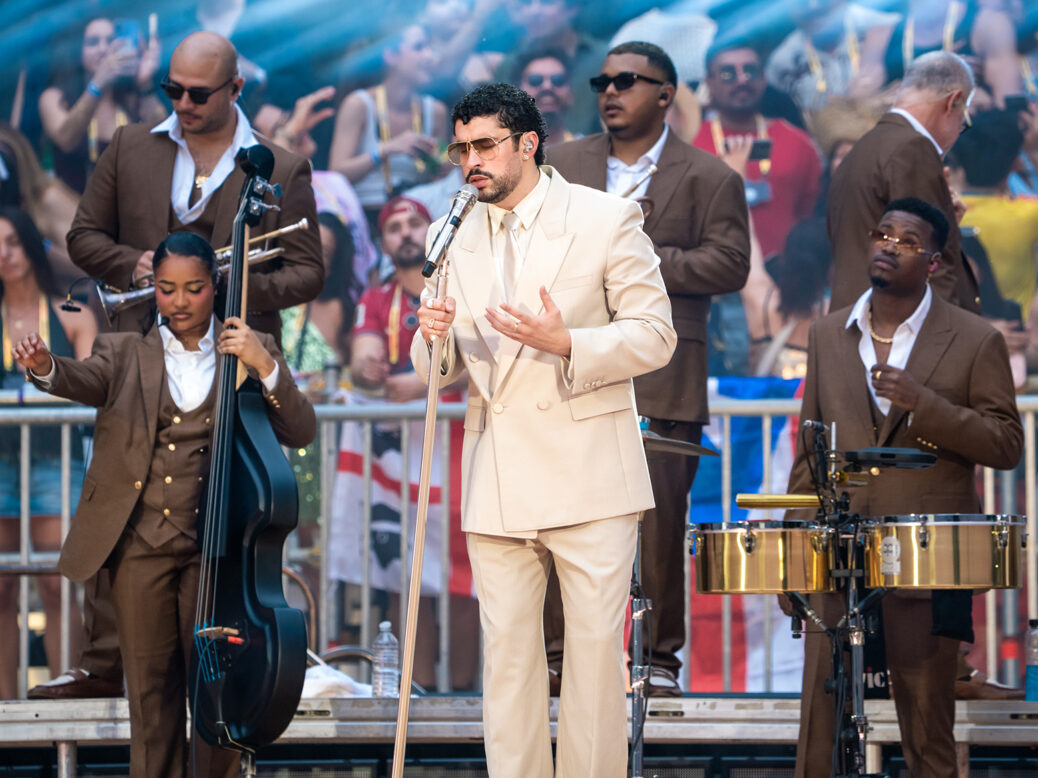
Bad Bunny, whose name is Benito Antonio Martínez Ocasio, emerged from a trap door in a summery beige suit paired with gold aviator glasses, to chants of “Benito”. The fans were drowned out by salsa dura drums and trumpets. The concert turned into a party.
Each track of the 31-song setlist transported the audience further away from London and closer to the sweltering heat of Puerto Rico. Fans swayed with fake camelias of varying hues in their hair, bunny ears and pavas – straw hats associated with the left-wing Popular Democratic Party – bobbing in the sea of bodies. The drums reverberated through the concrete, to your feet, and all the way up to your chest.

The rapper flitted through his discography, moving from the main stage to the single-storied pink casita – the diminutive form of house, favoured by the artist – on the opposite side of the stadium, fitted with its own air-conditioning unit and the characteristic Venetian blinds on the windows’ exterior.
Everyone danced: the couple to my left were lost in the step-touch movements of Bachata; the young girls to my right filmed one another swivelling their hips in figures-of-eight. Once the the romantic notes of the EDM anthem “Monaco” from his album Nadie Sabe Lo Que Va a Pasar Mañana (2023) filled the stadium, the crowd erupted. Shouts got louder, the movements wilder. Inadvertently, I found myself in a peculiar Newton’s cradle of bumping hips.
Bad Bunny’s music conveys more than words ever could. Lyrically, the songs are not dissimilar to others in the Latin trap and reggaeton genres. The tracks boil down to three main things: women, sex and partying. But there is something in the musical composition that moves people and connects them regardless of language barrier. It is impossible not to get caught in the moment and start swaying to the rhythm. One of the girls to my right barely spoke English, yet she managed to befriend two other girls further along the row who in turn did not know a word of Spanish. I saw Instagram handles exchanged and videos of dancing taken.
Bad Bunny is a symbol of unity. Though his music pays homage to his Puerto Rican heritage, there is a universality to it which touches millions of people. In the crowd, various flags fluttered as fans jumped up and down: Puerto Rican, Ecuadorian, Brazilian, Indian. Each was projected on the screens as the cameras panned over the audience. Bad Bunny’s anti-Ice speech at the Grammy’s and viral performance at the Super Bowl earlier this year broadcast his inclusive politics globally. His non-Spanish speaking fans don’t need to understand his lyrics to appreciate what he is about.
“Mientras uno estávivo uno debe amar lo más que pueda,” he shouted towards the crowd in the final throes of the concert. As long as one lives, one should love as much as one can. Who can argue with that?
[Further reading: The shame of the Frida Kahlo industry]
Content from our partners



Related
Join the debate
Subscribe here to comment